Showing posts with label Weber County. Show all posts

Wednesday, May 18, 2022

Trappers Loop and Snowbasin

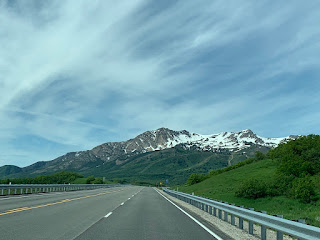
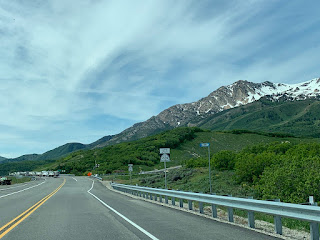
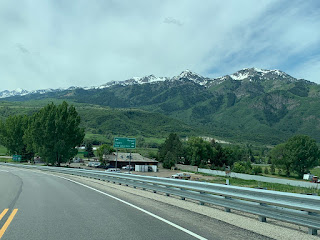
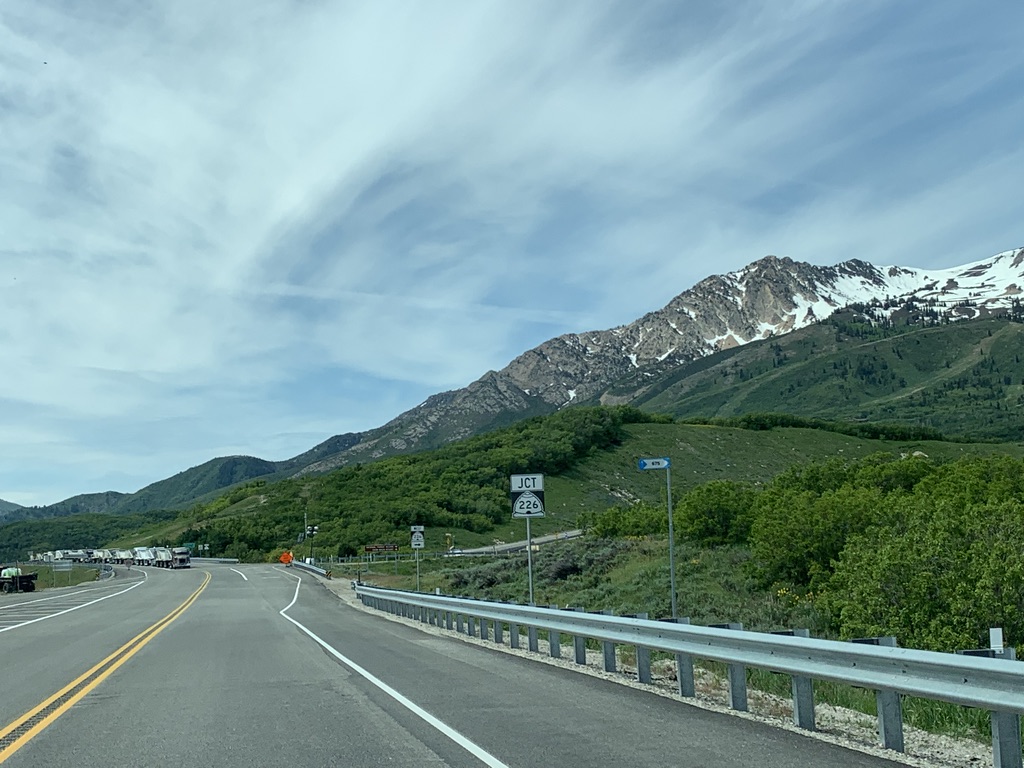
I'm baaaack! It's been a long time, but I've finally had the time to write up a new post. Today, I'll be discussing the history of the Trappers Loop highway in northern Utah and the roads connecting to the nearby Snowbasin ski area. Snowbasin is located in the snow-covered mountains in the background of the photo below, which was taken from southbound Trappers Loop Road (SR 167):

One of my all-time favorite road photos.


However, to start off, we'll need to go back to before Snowbasin even existed. As I mentioned briefly above, the Ogden Valley - including the communities of Huntsville, Eden, and Liberty - was a fairly isolated place in winter, and SR 39 through Ogden Canyon was the only original state highway connecting it to the outside world. While 39 is an awesome scenic drive, it generally isn't a great idea to have only one road in or out of someplace, and another state highway connection to the valley was probably seen as a good idea.

The ideal candidate for that connection was an old Shoshone trail connecting the Ogden River west of modern Huntsville to the Weber River near what is now Mountain Green. The trail was later used by early white settlers and fur trappers - hence the first half of its ultimate name of "Trappers Loop". The "loop" part is because these trappers would loop back and forth along the same trail, and not because the trail itself was a loop. Unfortunately, the name is not original, and was certainly not in widespread use until at least the late 1960s after it was published in some editorials in Ogden newspapers. 

At any rate, in 1935 the state legislature designated SR 85 along this corridor (note that "route 5" was the legislative designation for US 30S east of Ogden):

Route 85. From Huntsville on route 39 to Mountain Green on route 5.

According to a Deseret News article from 1990, the WPA conducted a road survey in this area in 1934, but this was not the road that was ultimately built. Neither did it directly follow the old Shoshone trail. Regardless, a dirt road connecting Huntsville and Mountain Green first appeared on the state highway map in 1935, and it was first labeled as 85 in the 1938 edition, suggesting it was probably completed around then.

USRC/Gousha, 1938.


That is about a mile east of the modern SR 167, by the way. SR 85 began at US 30S at Mountain Green (not west of it, like today's road) and proceeded northeast up the Dry Creek canyon, then crossed the pass and went directly into downtown Huntsville to end at SR 39. Also of note is that some of the surrounding road alignments were different. Although US 30S was exactly where Old Highway Road is now in Mountain Green, SR 39 went directly through central Huntsville along First Street, which can be seen in the map below:
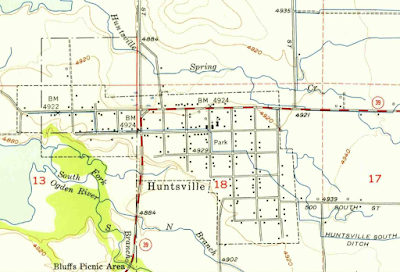
USGS (Huntsville), 1955.

SR 85 would have come into Huntsville directly from the south along what is now 7450 East (right by that "4902" label). It's not clear exactly how it ultimately connected to 39, but based on a 1940 census map (which I won't bother putting here as it shows pretty much the same thing) it appears 85 immediately turned north on 7500 East and proceeded up to 39 at First St.

By the way, much of that alignment is no longer drivable, for the same reason 39 no longer goes through Huntsville itself: in 1957, Pineview Dam was raised to its modern height, and much of the land south of Huntsville was flooded. However, during times of low lake levels, the old alignments can still be seen, with old 39 at left across the mud flats and old 85 to the east, directly south of the "Huntsville" label on the satellite image below. 
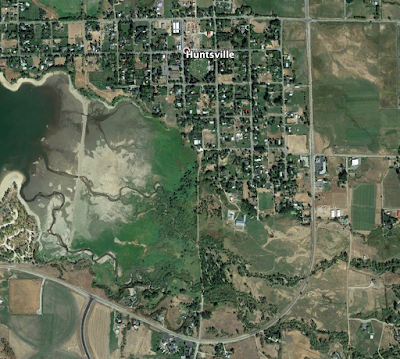
Google Earth, 2018.

However, 85 didn't last long enough to be affected by those realignments - the route was decommissioned in 1945 - only ten years after it was created. The road itself would continue to serve as a seasonal, locally-maintained dirt road.

Around this same time was the opening of Snow Basin (now Snowbasin) in the Wasatch mountains east of Ogden and west of the Trappers Loop road. This area had been previously been over-logged and overgrazed, and the land surface had been stripped essentially bare due to these aggressive practices. As a result, it began to produce debris flows whenever it rained hard enough (similar to a wildfire burn scar), and eventually a heavy summer thunderstorm in 1923 caused a major flash flood that killed many people and washed away several businesses. Ogden and Weber County, determined to never let that happen again, bought up the land in that area and transferred it to the Cache National Forest for restoration. The Forest Service and local skier Alf Engen committed to creating a ski resort recreational destination there. A rope tow opened in 1939, but there was no easy road access to the new ski area until 1940, when the Civilian Conservation Corps built a road south to the new resort from SR 39. That was added to the state highway system the next year as SR 226, and SR 227 was designated at the same time in the same area:

Route 226. From route 39 near Huntsville southwesterly to Mt. Ogden.

Route 227. From route 39 near the Pine View Dam southeasterly to route 226.

Below is a USGS topo map of the Snow Basin area:

USGS (Snow Basin), 1955.

SR 226 is shown clearly there, and as you can tell by comparing with a modern map, it does not match the current SR 226 to Snowbasin (we'll get to that in a minute), and the original entrance to the ski resort was also at a different location corresponding to what Google currently labels "S Wc226 Rd". But what about 227? Based on the legal description, SR 227 was supposed to follow Wheeler Creek, which has its headwaters at the base of Snowbasin, flows north parallel to 226 for a bit, then turns north and empties into the Ogden River right below Pineview Dam. 227 actually appeared on this map:
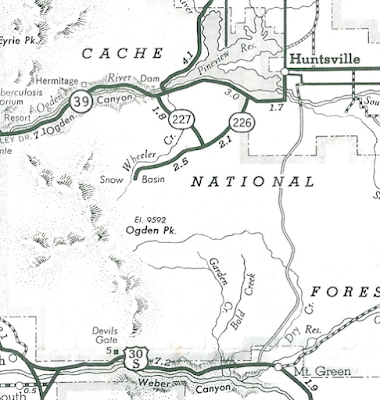
Flying A Service (Salt Lake City), 1944.

This is fascinating, but I believe it's an error. As far as I can tell, nothing was ever built along the creek between 226 and 39. The 227 designation would be deleted in 1953.


No further changes occurred in this area for over thirty years. But in 1984, at the request of Morgan and Weber county officials, the old Trapper's Loop Road (pre-1945 SR 85) was restored to the state system, this time as SR 167. The 1985 legislature approved that addition, defining the route as follows:

From Route 84 northerly via Trapper's Loop Road to Jct. Route 39 south of Huntsville.

Now, one might notice that Trappers Loop Road ends at Old Highway Road (old US 30S) and does not actually intersect I-84. That connection may have been planned to be constructed early on, but other issues with 167 soon took priority. The original idea was that UDOT would reconstruct and pave old Trappers Loop Road to modern state highway standards, but it was quickly realized that this would be prohibitive due to steep grades near Huntsville and other geological considerations including unstable soil and landslide areas. As a result, it was decided that an entirely new alignment would be built about a mile west of the old one, and this was approved in a 1987 Utah Transportation Commission resolution:
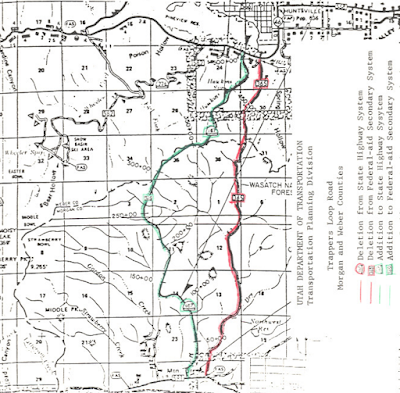
UDOT, 1987.

The decision of what to do with the old road was apparently quite contentious. Landowners on the Morgan County side wanted the old road closed immediately and given over to private control, as they believed this would decrease trespassing and property damage that they were experiencing. However, Weber County wanted the road kept open and under some level of public control, because they believed trespassing and property damage would actually increase if it were to be turned to private control. It seems several land parcels in this area were not adjacent to the old road, so one would have to travel across other property to access these areas. Owners of these non-adjacent parcels were worried that eliminating the public right-of-way would weaken and hinder their access rights, while other owners were worried that trespassing across their land to access these parcels would increase.

Ultimately, it was determined that the old road would remain under UDOT maintenance, open as a seasonal road as it had been for years before, until the new western alignment opened. As soon as that happened, SR 167 would be moved there, and Old Trappers Loop would be returned to the counties, which would then be able to do as they pleased with it. 

The new Trappers Loop Road opened in September 1989, as a three-lane road (two uphill lanes, one downhill). As promised, Morgan County rapidly abandoned their section of the old road (though it looks like part of it has since been incorporated into a newer subdivision). In fact, the south end of the old Trappers Loop is barely even noticeable today from Old Highway Road, appearing as an inconspicuous dirt driveway with a faded ROAD CLOSED sign (Google maps link). The Weber County side is still drivable for some distance but is now closed and gated off about a half-mile up from SR 39.

The opening of New Trappers Loop opened a couple more cans of worms. The first was the south end of SR 167, which did not connect to any other state highways or the interstate. To remedy this, SR 167 was extended west along Old Highway Road to I-84 exit 92 in 1990.

UDOT, 1990.

The other issues involved the potential of access to Snowbasin from the new highway. It was realized early on that it would probably be fairly easy to construct a road from SR 167 west to Snowbasin that would be much shorter and probably safer than the existing connection from SR 39. Further pressure to build this road came when Salt Lake City was awarded the 2002 Winter Olympics and Snowbasin was chosen as the venue for the Downhill, Super-G, and Combined ski races. In 2001, UDOT awarded a contract to build this road, and the old alignment would be transferred to Weber County as soon as the new road was built and UDOT had done one final repave on the old road. The new road was designated as a relocation of SR 226.
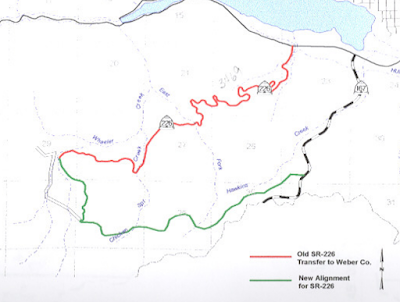
UDOT, 2001.

What's interesting about this is that the route endpoints weren't the same. Snowbasin built a new base area slightly to the northwest of the old base, so the new SR 226 actually overlapped around a half-mile of the old one (though in the opposite direction), and this created essentially one long connection from SR 39 to SR 167 that went by Snowbasin. Snowbasin planned to build a roundabout at the intersection of this road and the road to the new base area. UDOT wanted no part of constructing or maintaining this roundabout, so the west end of the new SR 226 is just east of that intersection.

(By the way, that roundabout was never built. But there's still plenty of room for one.)

UDOT retook temporary jurisdiction of the old SR 226 alignment between January 1 and March 15, 2002 so that there would be two state-maintained roads to Snowbasin during the Olympics. After that, the Old Snowbasin Road was given back to Weber County for good, and it is now inventoried as Federal Aid Route 3469. For several years, the county continued to maintain it as a summer-only alternate route to Snowbasin. However, this proved quite difficult as it travels through an especially landslide-prone area, and the road never opened for summer 2011 due to the severe landslides and road damage following the exceptionally wet 2010-11 winter season. Since the road is no longer necessary as a through route, the county moved quite slowly to fix it. According to one blog post I found, the county repaired some segments in 2014 and was on track to open the road in summer 2015...but I don't think that ever happened, and it now appears they've pretty much given up on ever reopening it. The old Snowbasin Road is now permanently closed to automobile traffic between Snowbasin and the Art Nord Trailhead, which is about halfway up to the ski area from SR 39.

Despite those issues in the area, ever since the Olympics SR 167 and SR 226 have remained intact with only routine maintenance and no route changes. UDOT's long range plans does have an extension of Trappers Loop Road south to I-84, where a new interchange will be built; however, this is currently unfunded and likely won't happen before 2040 at the absolute earliest. If the current plan is any indication, Trappers Loop will be widened to four lanes long before any interchange gets built, and I can't see even that happening for at least another 15-20 years. 


Route Photos


SR 167


Photos from this route were taken in June 2019 and August 2021. Should be fairly obvious based on background colors which is which. :)


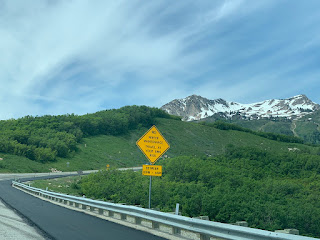
Initial reassurance shield after turning onto the highway. Apparently this is also a Utah Scenic Backway, which is weird because this road is hardly "back". This is probably the only backway that's three lanes the entire way.

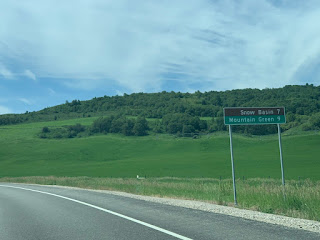
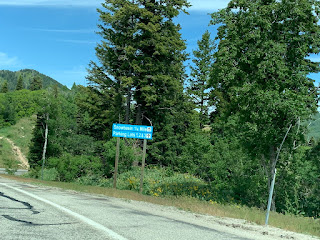
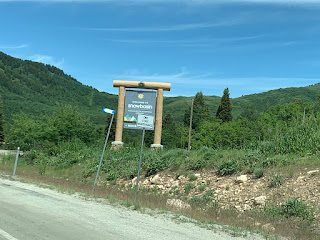
7 miles to Snow Basin, which is still typically spelled the old way on UDOT signage (two words instead of one). Another 2 miles to Mountain Green.

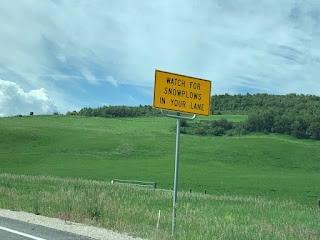
A typical sign for a Utah mountain road.

As we climb up higher, we'll start getting the tall orange poles that help snowplows find the road during heavy winter storms

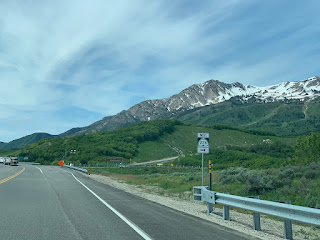
Awesome views abound on this road in the springtime.

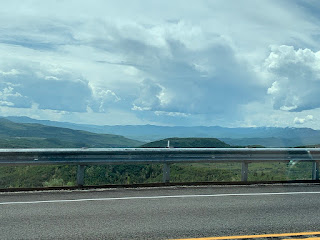
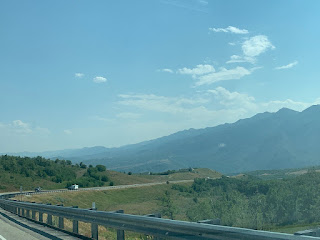
Looking to the south into the Morgan Valley. This stretch of 167 meanders across the Ogden/Weber river divide and thus the Weber/Morgan county line for some time

Coming up on SR 226, the New Snowbasin Road.

Turn right for SR 226 west, which goes to Snowbasin and provides access to the National Forest

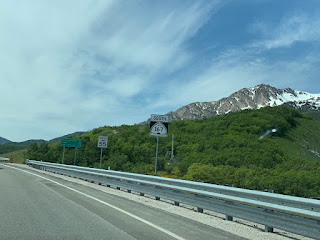
SR 167 reassurance shield after that junction. We'll cross the ~6040 foot summit and enter Morgan County for good here.

The descent into Morgan County features great views of the eastern side of the Wasatch ridgeline, which is a lot less steep than the western side

This little sign welcomes us to Mountain Green.

At the bottom of Trappers Loop Road, we can turn left for Morgan or right for Ogden and Salt Lake City

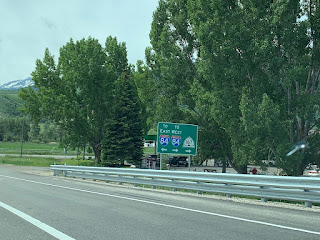
SR 167 will turn right on Old Highway Road towards I-84 west. That's a half-diamond interchange with no access to I-84 east, so turn left if that's your ultimate goal.

Old Highway Road to the east is Federal Aid Route 1978.

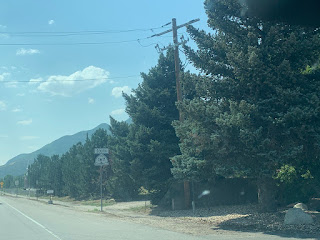
SR 167 southbound reassurance shield after making that right turn.

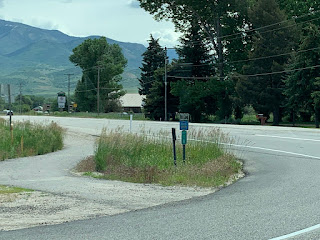
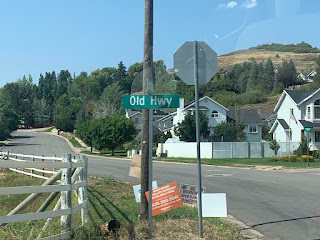
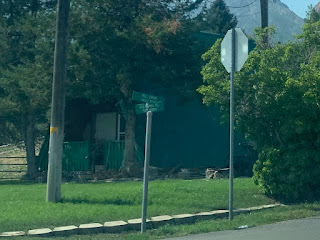
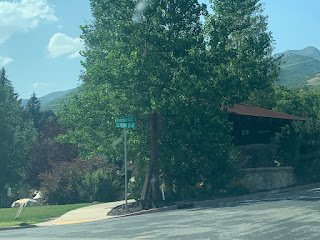
The signage of this road varies wildly. Most newer street signs simply say "Old Hwy"...

...some use the full "Old Highway Rd"...

...while others use "Old Highway SR-167" - which isn't quite true, since this is still 167

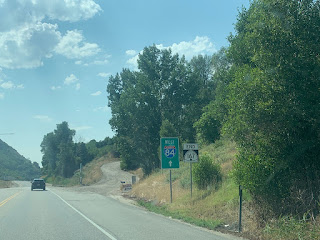
SR 167 ends not far ahead and defaults into an on-ramp to westbound I-84.


SR 226


All photos here were taken June 2019.
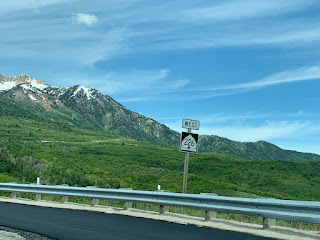
Reassurance shield posted as we leave 167 towards Snowbasin

Despite the ski resort, this road is not even plowed at night. They can get away with this because Snowbasin does not have any lodging at the base, nor does it have night skiing.

These ski-run type signs tell us to continue ahead 1/4 mile to Snowbasin. These are probably there from when the base area was originally moved 

State maintenance ends.


Tuesday, July 28, 2020

SR 39 and Eastern Ogden

One of the most scenic drives Utah has to offer is the Ogden River Scenic Byway, which is really two drives rolled into one: Ogden Canyon and the Monte Cristo Highway, both of which are SR 39. In this post, we'll look at the history of SR 39 as well as some of the routes it connects to in the Ogden area.

The view from Monte Cristo Peak, easily accessible from SR 39.

The road now known as SR 39 dates all the way back to July 18, 1911, when the state legislature added a road from Ogden to Huntsville to the state highway system. In 1919, this road was included in section F of the state highway law, which defined a corridor from Ogden through Huntsville and Woodruff to Randolph. Over the next two years, a federal-aid project made improvements to the Ogden-Huntsville road. The portion from Woodruff north to Randolph was transferred to another highway in 1921 (that would become SR 3, and is now SR 16). And in 1927, when numbers were assigned to all state highways, the Ogden-Woodruff highway became SR 39.

Back then, 39 followed significantly different alignments through Ogden and Huntsville than it does today. The original western terminus was in downtown Ogden, at Washington Blvd (US 91) and 24th Street. From there, it went east on 24th, north on Harrison Blvd, and northeast on Valley Drive into Ogden Canyon:

US Census, 1940.

It also followed a different alignment through Huntsville. Before 1934, Pineview Reservoir did not exist. I don't know of any detail maps of the area from that far back, but this map suggests a route into Huntsville directly from the west:

Rand McNally/Texaco (Idaho-Montana-Wyoming), 1937.

Perhaps that route came through Cemetery Point and entered directly on First Street. At any rate, construction on Pineview Dam began in 1934...but the dam was smaller than it is now, and Huntsville was simply located at the east end of it rather than on a peninsula. The new 1930s alignment of SR 39 entered from the south on 7100 East, then turned east on First Street:

USGS (Huntsville), 1955.

In 1935, the state created SR 103, continuing a state highway south on Harrison to US 30S southeast of Ogden:
From junction with route 39 in Ogden southerly via Harrison Avenue to junction with route 5 near Uintah.
Route 5 was just the legislative designation for US 30S and soon-to-be-extended US 89. At the time, the road that now carries US 89 did not exist in the eastern part of South Ogden. Instead, 30S/89 ran along what's now 5600 South and Wasatch Drive, and the point where Harrison intersected those roads was the southern terminus of 103:

US Census, 1940.

Not long after that, SR 203 was created along a similar alignment as 103, but north of 39:
From route 39 near Harrison Boulevard in Ogden, northerly via the Utah State tuberculosis sanatorium to Second street, thence west to the army supply depot.
Once again, we have to consider that several roads in the area didn't exist at the time: in particular, Harrison Blvd did not exist between today's 9th Street and 20th Street due to the Ogden River Canyon. Canyon Road did exist, but on an alignment slightly farther north and east than what is there today. SR 203 followed that northwest from Valley Drive (SR 39) at the mouth of Ogden Canyon to Mountain Road, north to 9th Street, and west to Harrison Blvd - which did exist north of 9th.

From there, SR 203 went north on Harrison and passed the Utah state tuberculosis sanatorium. (The Utah School for the Deaf and Blind now occupies this location; the site has been served by a series of state routes that will be covered in a future post.) The route turned west on 2nd Street, crossed US 30S/89/91 and SR 204, and continued on to the US Army's Utah General Depot - presumably created due to the outbreak of World War II. Based on topo maps, it looks like the actual west end of SR 203 was located just east of the Union Pacific railroad crossing.

At some point around 1950, US 89 was moved to its modern alignment through South Ogden. This required a short southward extension of SR 103, bringing its southern terminus very close to where 203 ends now (more on that later).

In 1953, the entire north-south portion of SR 203 was truncated, leaving only the part on 2nd Street from the defense depot to Harrison Blvd. That was the case when this map was made. Although no 203 shields made the map, it's fairly obvious where the route went, and the old alignment southeast to SR 39 at Valley Drive is visible as well.

USGS (Ogden/North Ogden), 1955.

(The SR 38 shield on that map is an error; usually older USGS maps are more accurate, but the occasional mistake does make it in here and there.)

Meanwhile to the east, Pineview Dam west of Huntsville was raised 34 feet to its modern height in 1957. This would flood some of the lowlands near Huntsville and put the town on the peninsula it occupies today, but it also meant a new alignment was needed for SR 39. The new road completely bypassed Huntsville to the southeast; it hasn't changed since, and it can be seen on the modern aerial imagery below. 

Google Earth, 2018.

That image was taken in the fall after one of northern Utah's driest winters on record, so the lake level is lower than normal. During such times of low water, the old SR 39 alignment into Huntsville from the south becomes exposed - the road itself has washed away, but the embankment upon which it sat is clearly visible, cutting across the wetlands near the left edge of the image. And if you take a close look at the old roadway, you'll notice the original bridges over both branches of the South Fork Ogden River still stand. But that old alignment wouldn't even be drivable in an ATV without fording streams; a small stream near the north edge of the lake has cut directly through the embankment, as has the South Branch of the South Fork Ogden River - bypassing the original bridge.

Returning back down to Ogden a few years after that, the city requested a mileage swap with UDOT. They wanted to make 12th Street from Washington Blvd (US 30S/89/91) to Harrison Blvd a state highway, in exchange for removing nearby SR 183A (7th Street) from the state system. (Of course, note that Harrison didn't exist at 12th yet.)  This was done in August 1963, and approved by the legislature the next winter. The new highway on 12th Street was designated SR 205.

UDOT, 1964.

But that highway wouldn't even last a year. In 1963, SR 39 was rerouted off 24th Street and Valley Drive and onto 12th Street and Canyon Road - absorbing the year-old SR 205. The portion on Valley Drive was removed from the state system, while the 24th Street segment became an eastward extension of SR 37 (we'll talk about that in a future post, too).

In addition, at this time SR 203 was extended back south, but this time all the way to US 89. From 2nd to 9th Streets, it followed its pre-1953 routing. It then followed a proposed connection through the Ogden River's floodplain to 20th Street/Valley Drive, where it took over the four-block section of SR 39 between 20th and 24th Streets. South of 24th, it completely absorbed SR 103, eliminating that state route designation. The new connection between 9th Street and 20th Street would be completed a few years later in 1967. 

The 1964 changes are shown on this map. To avoid unnecessary clutter, with the exception of the US Highway through town I've left off any routes that do not directly relate to this blog post.


In 1965, SR 39 was extended west again to 1900 West (SR 84, now SR 126) in order to serve the new 12th Street interchange on I-15. And in 1969, it was extended even further to 4700 West (SR 40, now SR 134) although this extension was not open until the following year.
The fact that 39 was extended in 1969 is somewhat unusual; that year featured a systematic mass decommissioning of over 90 state routes, and even more were truncated in some way. SR 203 was one of those: the entire route north of 12th Street (SR 39), including the portion on 2nd Street and the connection to the Defense Depot, was turned back to local jurisdiction. That reduced 203 to its current extent.

SR 39 would receive a few minor realignments in the Canyon Road area. The 1964 map above shows a sharp curve where 12th Street became Canyon Road; that had been straightened out by 1970. Two more minor realignments would occur between Harrison and the mouth of Ogden Canyon; here is a 1970 document showing them:

UDOT, 1970.

SR 39 has not changed since then, but the south end of SR 203 has gone through multiple stages of reconfigurations. The original configuration was a skewed intersection, but it looks like it probably was not possible to continue straight through northbound:

USGS (Ogden), 1967.

Note the erroneous SR 103 designation...103 had changed to 203 three years before. This was fixed on the 1970 map, but by then the intersection had also been reconfigured to two intersections (probably in conjunction with widening US 89 to four lanes). The main 89/203 intersection became a standard 90-degree intersection, with the previous alignment being used for a right-turn lane. The continuation of Harrison southward is known as 1550 East; it got its own three-way intersection with 89.

USGS (Ogden), 1970.

That was a relatively short-term arrangement, though. By 1978, Harrison and 1550 East were once again combined into a single skewed intersection at US 89, probably to allow for a dual left from southbound Harrison:

Google Earth, 1993.

That image also shows the construction of a road running southwest from US 89 here. That would become Ridgeline Drive, but it did not connect to 89 due to its close proximity to the Harrison intersection.

Until 2015, that is. At that time, Harrison was once again realigned to a 90-degree intersection with US 89, this time connecting to Ridgeline Drive on the other side. The new intersection features a rare triple left turn from southbound Harrison to 89. 1550 East is now a right-in/right-out (RIRO) from southbound 89:

Google Earth, 2017.

In 2019, the right turn from northbound 89 to Harrison was widened to two lanes. And further updates to this configuration are likely coming in the near future: current plans call for US 89 to be upgraded to a freeway from Davis County north through I-84, and it will transition back to the current at-grade expressway somewhere in this area.


Route Photos


SR 39


We'll start out heading west from I-15:

Not long after leaving 15, the highway reaches a junction with SR 126. Stay straight for 39 west to Little Mountain, turn left for 126 south to West Haven, or turn right for 126 north to Farr West.

SR 126 runs along 1900 West here, while 39 is on 1200 South.

39 reassurance after the junction

In a couple miles the road reaches 4700 West, which carries SR 134.

Stay straight for Little Mountain.

SR 39 ends here, but the road goes on to Little Mountain and a few salt plants on the shore of the Great Salt Lake.

If you go just past that stop sign and flip a U-turn, you'll see that SR 39 has, in my opinion, one of the coolest views from the start of the route. This is a flat area near the Great Salt Lake, but there are awesome views of the Wasatch all the way into Ogden.

Now, we'll head east from SR 204 (Wall Avenue) in Ogden:

SR 39 reassurance marker heading east on 12th Street.

In a few blocks, we'll reach US 89 at Washington Boulevard. Turn left there for the ATC (Ogden-Weber Applied Technical College); stay straight for the Eccles Dinosaur Park.

US 89 runs either way on Washington Blvd, which also used to be US 91 and US 30S. Stay straight on 12th for SR 39 east.

After another mile, we'll turn slightly to the southeast and come upon a junction with SR 203.

Stay straight for the Eccles Dinosaur Park, or turn right for Weber State University including the Dee Event Center.

SR 203 begins to the right on Harrison Blvd.
Although Ogden Canyon ahead is quite scenic, pedestrians and cyclists probably shouldn't be on this road because it has very little in the way of shoulders. Bicycles are much better off on the North Ogden Divide road a few miles north of here. 

Some sort of pipe is suspended across the mouth of the canyon.

In winter, you'll need snow tires or chains if you want to go to Snowbasin or Powder Mountain.

Based on the amount of green in these photos, you can probably guess fire danger is low. But we have Smokey the Bear to confirm it.

Another narrow shoulder warning sign.

Not a lot of people regularly take this as a scenic drive, but I happen to enjoy it. It looks even better in spring when everything is green.

Coming up is Pineview Dam.

Due to the large snowpack that accumulated during the winter of 2018-19, the reservoir was full and plenty of water was coming down the spillway. SR 158 runs along the crest of the dam, running north to Eden and Powder Mountain.

After another few miles along the south side of Pineview Reservoir, we reach a junction with SR 167 at Trappers Loop Road. Turn there for Snowbasin, Mountain Green, Morgan, and probably the fastest route to Salt Lake City.

After passing around Huntsville, SR 39 will head up the Monte Cristo Highway, following Beaver Creek up the western approach.

A gate is ahead - in this case, the gate where the Monte Cristo Highway closes during the winter months. The relatively low traffic levels and large amounts of snow that fall in this area do not justify keeping it open in winter. 

The general theme of this drive was "sighting distant mountain ranges". Here, peeking through the trees, is the east side of the ridgeline forming the Morgan-Davis county line.

Visible here are the Wellsville Mountains, which lie west of Logan.

I drove this again in October 2019, but obviously I missed the peak of the good leaf season. Apparently it would have been awesome if I'd been here just two weeks before.

A map I had once marked this as a Best of the Road™ Route. I can see why.

The road actually meanders across the Cache County line several times, but we only get one sign for it. This is a significant drainage divide, as water takes two different paths to reach the Great Salt Lake: the Weber County (south) side drains to the Ogden and Weber Rivers, while the Cache (north) side drains to the Little Bear and Bear.

Looks like the snow accumulation season has already begun. SR 39 comes close to 9000 feet but does not exceed that elevation line, making it the lowest-elevation seasonal road in Utah. 

This is one of those signs that flips open and closed, which may explain some of the ugliness associated with it.

I don't think there was a sign, but at some point we enter Rich County, which still drains to the Bear River but to a much higher part of it, via Birch and Woodruff Creeks. The Bear River runs at about 6400 feet where Woodruff Creek empties into it; at the Little Bear mouth in Cache County, it's about 4400 feet.

Open, treeless meadows like this have always fascinated me.

But it doesn't last long, as we'll soon drop into a small canyon occupied by Birch Creek.

This area has a surprising amount of outcrops of red rock. Normally, one thinks of that as a southern Utah thing.

A few miles down from there, the highway enters Woodruff.

Woodruff is most notable for its highway junction between SRs 39 and 16.

Turn left for Garden City, Utah; right for Evanston, Wyoming.

SR 39 ends here, almost 68 miles from and 2200 feet higher than its other end by the Great Salt Lake.

SR 203


SR 203 southbound will begin at 12th Street and head south on Harrison Blvd without a reassurance shield. Before climbing up onto the Ogden bench and Weber State University, we cross the Ogden River.

In a mile or so, the highway will come up on SR 79.

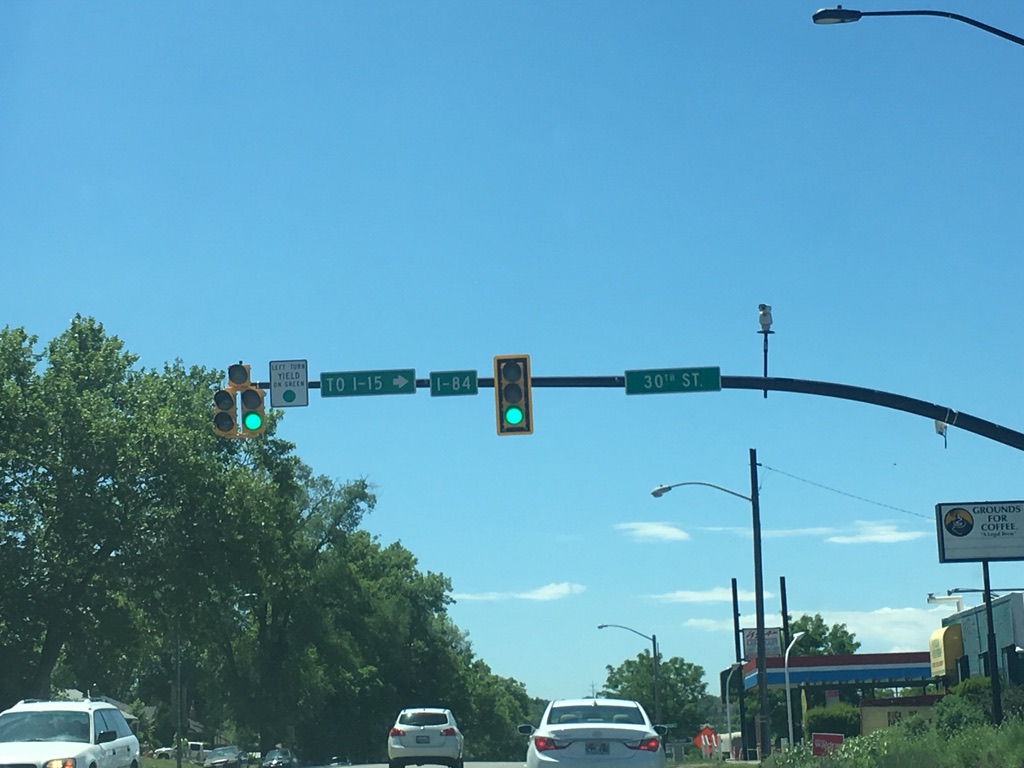
SR 79 begins to the right here on 30th Street.

What they meant to say was "for I-15/84, turn right here". But this is a rather strange way to sign that...especially because if your goal is I-15 south or I-84 east, it's probably better to stay straight here and take US 89.

Many of the traffic signals around Weber State are newer and so have the shield in addition to the street name.

Another newer street blade, but this time with the route number as a secondary name instead of a shield.

SR 203 comes up on its junction with US 89, which is signed with this nice older-spec shield.

Just after that light, we'll get another, much newer JCT 89 sign...which is probably why the old one is still there.

Either direction is US 89. SR 203 ends at the light ahead, where the vast majority of traffic will turn left onto US 89 southbound. So much traffic, in fact, that there are 3 turn lanes.